
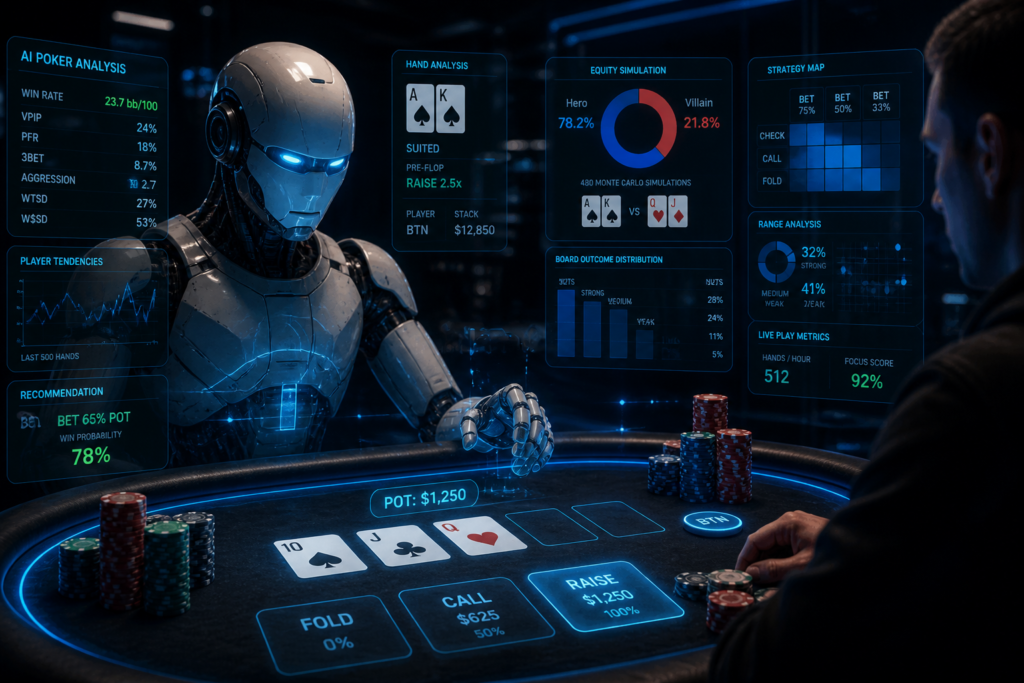
The Hidden Problem With Most AI Poker Bots in 2026
For years, the online poker world has been flooded with bold claims about AI poker bots.
Faster decision-making. Smarter hand reading. Automated grinding. Higher win rates.
But behind the marketing language, most systems still suffer from the same core weaknesses they had years ago.
And serious players are starting to notice.
The truth is that modern online poker environments have changed dramatically. Games are tougher. Detection systems are more advanced. Player pools adapt faster. Strategies evolve weekly instead of yearly.
Yet many poker automation systems still rely on outdated logic trees, predictable patterns, and rigid action frameworks.
That gap between modern games and outdated automation is exactly why many traditional poker bots are quietly becoming obsolete.
In this article, we’ll break down:
- Why older poker bots struggle in modern games
- The biggest mistakes AI poker systems still make
- What separates adaptive AI systems from static bots
- How advanced poker analysis tools are changing online poker strategy
- What experienced players now expect from AI-assisted poker technology
Why Traditional Poker Bots Started Falling Behind
Several years ago, basic poker bots were often enough to survive in softer online games.
Most systems followed simple structures:
- Predefined ranges
- Fixed bet sizing
- Basic HUD-driven reactions
- Static postflop rules
- Limited opponent adaptation
At lower stakes, this worked reasonably well.
But modern online poker ecosystems became significantly more aggressive and data-aware.
Today’s player pools:
- Exploit repetitive timing patterns
- Adjust rapidly to predictable frequencies
- Use advanced tracking software
- Recognize population tendencies faster
- Punish rigid postflop strategies
That means static automation no longer blends naturally into competitive environments.
And once a system becomes predictable, long-term performance usually collapses.
Why Traditional Poker Bots Are Becoming Obsolet
The Biggest Weakness of Older AI Poker Systems
The biggest issue isn’t speed.
It’s predictability.
Many older poker bots still make decisions using highly repetitive logic.
For example:
- Same continuation bet sizing
- Identical river bluff frequencies
- Repeated timing patterns
- Fixed response structures against aggression
- Over-reliance on prebuilt charts
Real players don’t behave like that.
Strong human players constantly adjust.
They react emotionally. They exploit table dynamics. They change pacing. They modify aggression based on flow. They adapt to unusual player pools.
Modern AI poker analysis systems increasingly focus on reducing those predictable patterns rather than simply automating actions.
That shift is one of the biggest changes happening in poker technology today.
Adaptive AI Is Replacing Static Automation
One of the most important developments in AI poker software is adaptive modeling.
Instead of following fixed trees, newer systems attempt to analyze changing conditions dynamically.
This includes:
Table Dynamics
Modern systems increasingly evaluate:
- Overall table aggression
- Stack pressure
- Short-handed dynamics
- Frequency changes
- Session volatility
Opponent Profiling
More advanced analysis engines attempt to recognize:
- Over-folding tendencies
- Bluff-heavy players
- Passive recreational patterns
- Timing inconsistencies
- Unbalanced bet sizing
Strategy Variation
Rather than repeating identical lines, adaptive systems may vary:
- Bet sizing
- Bluff frequencies
- Check-back ranges
- River aggression
- Response timing
The goal is not simply automation.
The goal is reducing predictability.
And that difference matters more in 2026 than ever before.
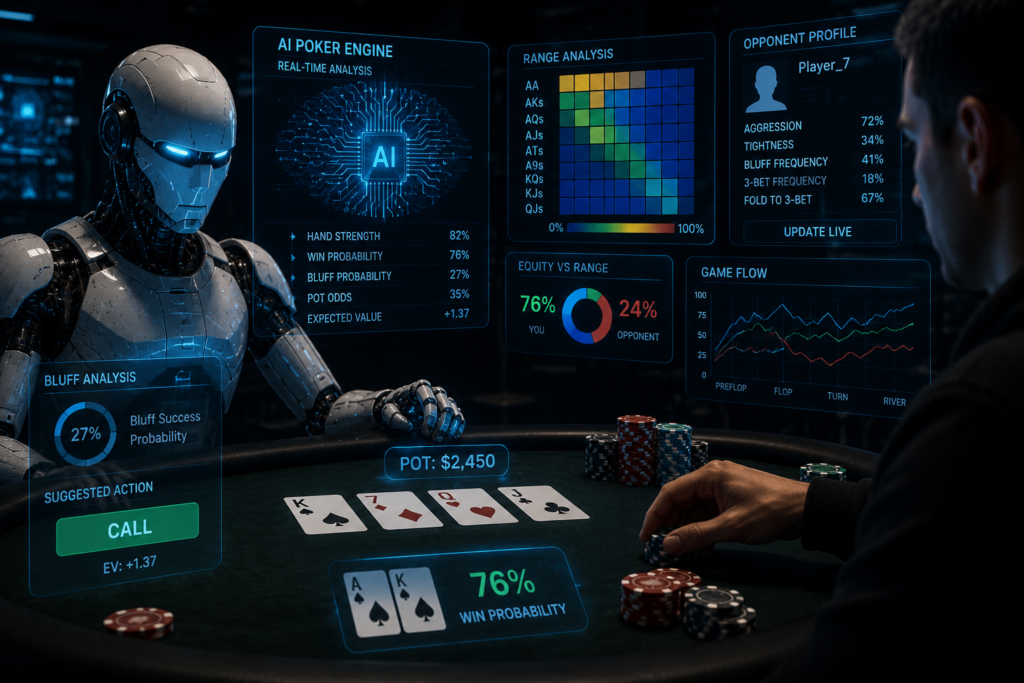
Why Serious Players Care More About Analysis Than Automation
Interestingly, many experienced players are shifting away from fully automated systems.
Instead, they’re looking for:
- Advanced AI-assisted analysis
- Hand review systems
- Leak detection
- Population analysis
- Strategic recommendation engines
- Real-time study tools
Why?
Because long-term poker success still depends heavily on adaptation and strategic understanding.
Pure automation alone often struggles when games evolve quickly.
Players who combine human decision-making with intelligent analysis tools typically retain more flexibility.
That’s why many modern poker AI platforms are increasingly positioned as strategic assistants rather than simple bots.
AI Poker Bot Guide (2026): How Modern Systems Actually Work
The Rise of AI-Powered Poker Analysis
AI poker analysis tools are evolving far beyond traditional HUD statistics.
Modern systems increasingly attempt to analyze:
- Multi-street aggression patterns
- Population leaks
- Frequency imbalances
- Exploit opportunities
- Session-level trends
- Psychological pacing patterns
This creates a much deeper strategic layer than older poker automation systems ever offered.
Instead of relying entirely on fixed charts, newer platforms focus more on contextual adaptation.
And in tougher games, context matters.
A lot.
What Modern Players Expect From AI Poker Technology
The expectations around poker AI have changed dramatically.
Players no longer just want “auto-play.”
They want systems that feel intelligent.
That means:
Natural Decision Variation
Modern players expect less robotic behavior and more flexible strategic adjustments.
Real-Time Adaptation
Games evolve quickly. AI systems that fail to adapt often become liabilities.
Data-Driven Recommendations
Strong players increasingly value analysis quality over raw automation.
Cleaner User Experience
Most serious users now expect:
- Faster interfaces
- Cleaner dashboards
- Real-time tracking
- Visual hand analysis
- Session review tools
The market is maturing.
And simplistic poker bots are struggling to keep up.
Advanced AI Poker Bot Systems: What Serious Players Look for Before Choosing One
The Future of AI Poker Systems
The future of poker AI likely won’t revolve around rigid automation.
Instead, the next generation of systems will probably focus more on:
- Strategic augmentation
- Adaptive learning
- Behavioral modeling
- Real-time analysis
- Human-AI collaboration
In many ways, poker technology is moving closer to how advanced AI systems are used in other competitive industries.
The strongest systems won’t necessarily be the most aggressive.
They’ll be the most adaptable.
Best AI Poker Bot Features: What Actually Matters in 2026
Final Thoughts
The online poker landscape in 2026 is significantly more complex than it was just a few years ago.
Static poker bots that rely on repetitive logic and predictable patterns are increasingly vulnerable in modern environments.
At the same time, adaptive AI-powered analysis tools are becoming far more sophisticated.
For serious players, the conversation is shifting away from simple automation and toward intelligent strategic support.
And that shift may ultimately define the next era of poker technology.
Explore more advanced AI poker strategy insights and modern poker analysis systems on PokerBotrix.