
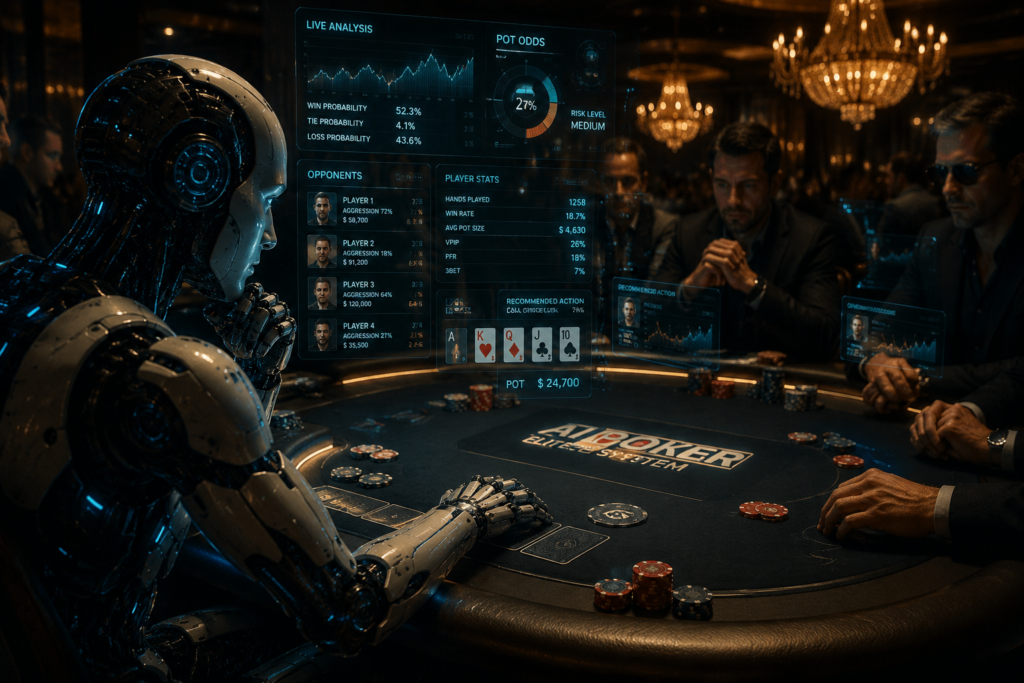
Most Players Focus on the Wrong Things
When people first start looking for a poker bot, they usually focus on the obvious things.
Win rate screenshots.
Short-term results.
Aggressive marketing claims.
Quick demos.
At first, that makes sense.
But experienced players tend to look at completely different details.
Because once you’ve spent enough time around poker bots and poker automation systems, you realize something important:
Almost every poker bot can look good for a short period of time.
The real difference only becomes visible later.
Short-Term Results Mean Almost Nothing
This is one of the biggest misunderstandings in the poker bot space.
A bot running well for an hour — or even a few sessions — doesn’t really prove much.
Poker has variance.
Good runs happen.
Bad runs happen.
And many traditional poker robots are specifically designed to look strong in small samples.
That’s why experienced players rarely judge a system based on short-term testing alone.
They care about long-term behavior.
Why Most Poker Bots Eventually Become Predictable
This is where most systems quietly fail.
Not immediately.
Over time.
Traditional poker bots usually rely on fixed logic and repetitive decision structures.
At first, the consistency feels impressive.
But after enough hands, patterns start appearing:
- Similar reactions in similar spots
- Repeated timing behavior
- Static decision trees
- Predictable aggression frequencies
And once that happens, performance starts dropping.
Not because the bot suddenly became “bad” — but because predictable behavior becomes easier to exploit over large volume.
This is one of the main reasons many poker bots look strong early on and weaker later.
Serious Players Think About Exposure
Experienced players don’t only ask:
“Can this win?”
They ask:
“How long can this hold up?”
That’s a completely different mindset.
Because high-volume environments expose patterns very quickly.
And once a system starts behaving too mechanically, long-term stability becomes difficult.
This is why serious players quietly pay attention to things most casual users ignore:
- Adaptability
- Decision variation
- Context awareness
- Behavioral consistency over time
Those details matter far more than short-term graphs.
The Difference Between Automation and Intelligent Decision-Making
A lot of poker bots are built around automation.
But automation alone is no longer enough.
Executing actions quickly is easy.
Making intelligent decisions consistently is much harder.
That’s where modern AI poker bots are starting to separate themselves from older systems.
Instead of following completely fixed behavior, advanced AI poker robots evaluate situations dynamically.
That includes factors like:
- Table dynamics
- Positioning
- Opponent behavior
- Risk distribution
- Game flow
The goal is not simply to automate actions.
The goal is to make more natural and adaptive decisions over time.
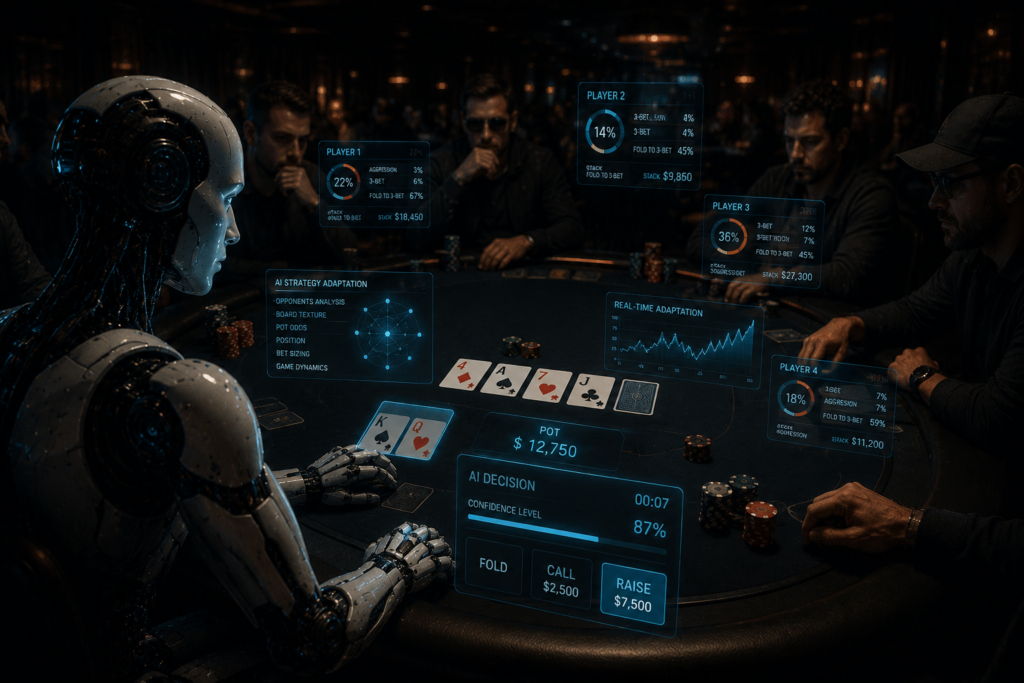
Why Adaptability Matters More Than Aggression
One common mistake in poker bot design is confusing aggression with intelligence.
Aggressive systems can sometimes produce strong short-term results.
But aggression without adaptation becomes predictable very quickly.
Experienced players understand this.
What actually matters is controlled adaptability.
A system that can adjust its behavior based on changing conditions tends to remain stable far longer than one built around static patterns.
That’s one of the major shifts happening inside modern AI poker bot development.
High-Level Players Care About Stability
Casual users often chase fast results.
Serious players usually care about stability.
That includes:
- Long-term consistency
- Controlled behavior
- Sustainable performance
- Scalable operation
- Lower pattern exposure
Because in high-volume environments, survival matters just as much as profitability.
And stability is usually what separates professional systems from disposable ones.
Why Volume Changes Everything
A small test session rarely tells the full story.
Real evaluation happens through volume.
Over thousands of hands, weaknesses become visible:
- Repetitive logic
- Poor adaptation
- Timing consistency
- Over-aggressive reactions
- Static decision structures
This is why serious players evaluate systems very differently from beginners.
They understand that long-term behavior matters more than first impressions.
The Poker Bot Market Is Changing
A few years ago, simple automation was enough for many environments.
Today, things are becoming much more competitive.
The gap between basic poker robots and advanced AI poker systems is growing quickly.
And players who understand that shift early usually gain the biggest advantage.
Not because they are chasing hype.
But because they are focusing on systems designed for long-term performance rather than short-term appearance.
Final Thoughts
The difference between an average poker bot and a serious AI poker bot usually isn’t visible in the first hour.
It becomes visible over time.
That’s why experienced players quietly focus on adaptability, behavioral stability, and long-term consistency rather than marketing claims or short demos.
Because in the end, the systems that survive are rarely the loudest ones.
They’re the ones built to hold up under real volume.
The difference between an average poker bot and a serious AI poker system is rarely visible in the first hour.
It becomes visible over time.
And that’s exactly what experienced players pay attention to.
Want to see how modern AI poker systems behave in real environments?
Contact the PokerBotrix team for testing and setup information.